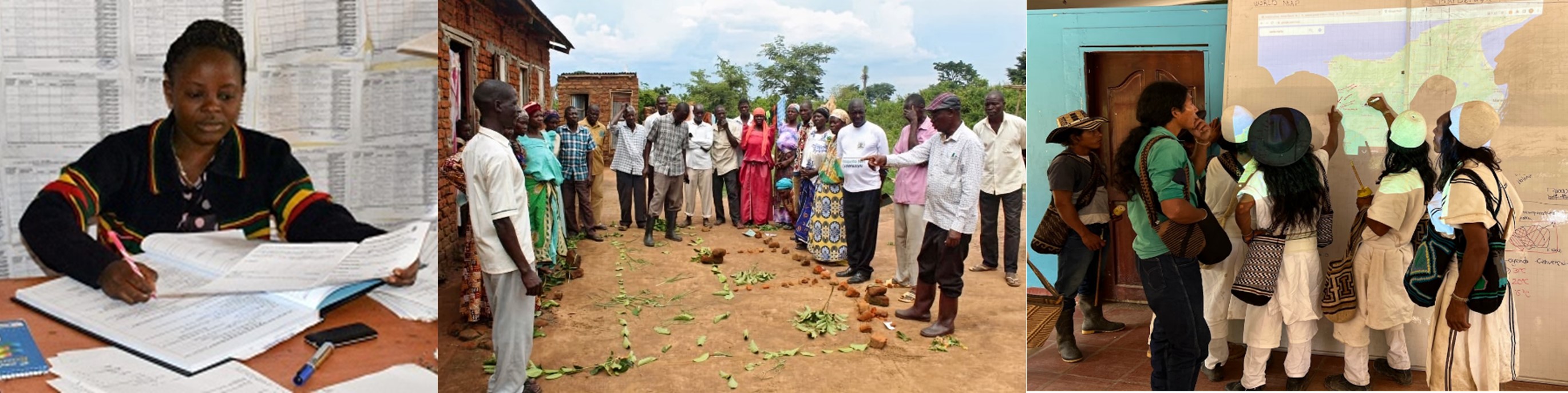
Description
The 2026 LANDac Summer School is focused on decolonizing land governance and the politics of conflict and peace. Since the start of the global land rush in 2010, land governance has increasingly been characterized by conflicts, compounded by crises of climate change, health decline, extractive capitalism, and geopolitical shifts. War and organized violence, and ‘old-fashioned’ conquests of land by states, is on the rise. Today, people in around 50 countries of the world are experiencing war or organized violence, affecting roughly one-sixth of the world population. Increasing numbers of people are displaced due to conflict, violence or political instability, and cannot return to their land.
In this course, we unravel this trend from a decolonial perspective on conflicts in land governance. Rather than viewing war, organized violence and land conquests as incidents or (temporal) escalations, we understand conflicts as rooted in colonial histories and unfair dynamics of land governance, connected to the interests of states and powerful private actors. Connecting these observations to everyday life, we view conflict as a broader phenomenon that ranges from intra-household and intra-community conflicts, to national and global geopolitical conflicts.
We discuss the multiple and competing claims on land by various actors (e.g. governments, private sector, communities, non-human actors) in relation to diverse types of conflict. Our approach is inspired by decoloniality and plurality of knowledges, which also means critically discussing the politics of knowledge and framing around land and conflict. We provide a space to explore plural interests, lived experiences, perspectives and knowledges around land. We actively involve participants in discussions on how to recognize land right practices and legal approaches whilst at the same time offering methods to develop realistic and fair land governance.
Key questions:
- How can we, as academics, practitioners, CSO’s and policy makers, position ourselves in debates on decoloniality, fair transitions and competing claims on land?
- How can we work towards more socially just, and inclusive and sustainable forms of land governance?
More concretely, we discuss for instance:
- How to reconcile vulnerable people’s rights to use land and build livelihoods on the one hand, with the depletion of resources on the other?
- How to secure land and housing rights of marginalized groups, especially for women, when many policy efforts seem to achieve the opposite?
- How to answer to the Global North’s reduced readiness to combat climate change, uphold the rule of law and promote human rights?
- How to prevent that the (land) ‘rights to nature’ movement, inspired by decoloniality and more-than-human approaches, is co-opted by nature conservation lobbies?
MSc students, PhD students and professionals / practitioners will acquire up-to-date knowledge on current issues of land governance in relation to conflict and peace; and learn how to place these in broader theoretical contexts and policy debates. Participants learn to critically reflect on ‘best practices’ in land governance from plural perspectives. Topics are discussed in interactive lectures with ample space for dialogue. The design of the course allows for participants to engage with professionals and fellow students from a variety of backgrounds. Participants collaborate to prepare a land-use plan/strategy that takes into account the complexities and pluralities of seeing and using land.
The course is organized by the Netherlands Academy for Land Governance (LANDac), in collaboration with RVO LAND-at-Scale, and the UU platforms / communities IOS Fair Transitions and Critical Pathways. LANDac is a network of organizations interested in how land governance may contribute to sustainable and inclusive development. The LANDac Annual Conference forms part of the Summer School program.
Day to Day Documents
S19 Summer School LANDac 2026 Booklet.pdf
Lecturers
Core faculty:
- Dr. Ir. Janwillem Liebrand
- Dr. Femke van Noorloos
A wide range of academics, both from the Global South and North, will present interactive lectures on their field of expertise.
Target audience
The course is designed for Master’s students, PhD students, academics; as well as for practitioners e.g. from development organizations, CSOs, social movements and governments who are interested in or work in the fields of land governance, development studies, natural resource management, planning, human rights and conflict studies.
Aim of the course
The course provides participants with thorough knowledge and plural decolonial perspectives of current issues in land governance and competing claims in relation to conflict and peace. Participants also build understanding of practical knowledge and possible solutions.
Study load
29 June - 10 July. Please note that the LANDac Annual Conference 2026, 1-2 July, and LANDac early career event, 3 July, form part of the programme of the Summer School.
Costs
-
Course fee:
€695.00
-
-
Included:
Course + course materials
The course fee includes the fee for the LANDac Annual Conference 2026. There are no scholarships available for this course.
Additional information
For the first week of this course, no student housing is available via the Utrecht Summer School. Please feel free to take a look at this page for hostel and hotel suggestions. You can of course also look for rooms at Booking.com or Airbnb.
If you wish, you can register for student accommodation during the second week of your course. You would be able to check in on 6 July 2026 (between 12.00 and 18.00) and you need to check-out on Friday 10 July 2026 before 10.00. In order to register, please direct an email via the contact page, so we can inform you how to proceed.
Tags