
Description
Social Impact Mindset is a five-day Utrecht Summer School course where companies, professionals, and students build practical social entrepreneurship skills and learn to turn social dilemmas into responsible action. Through fixed mixed working groups, participants work on real but shareable company, organisational, or societal challenges, step outside their own bubble, practise co-creation and active listening, and develop prototype ideas with first action steps.
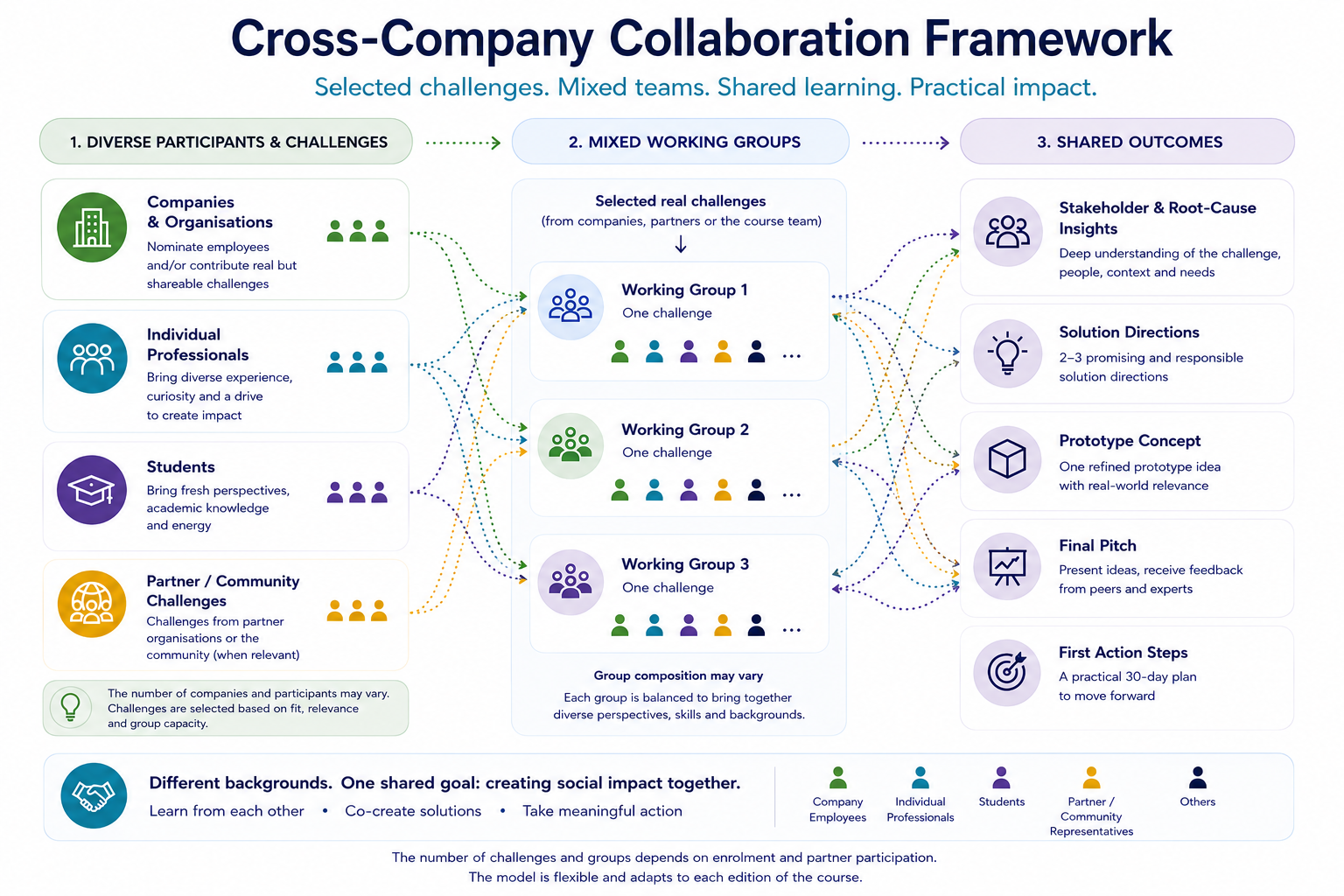
The course combines academic insight, cross-company learning, teamwork, innovation, sustainability, leadership, negotiation, coaching, co-creation dialogue, and prototyping. Participants work in mixed groups on a selected number of suitable challenges submitted by companies, partner organisations, or prepared by the course team.
The learning process moves from understanding a challenge to developing responsible action. Participants analyse root causes, stakeholder perspectives, affected communities, and what people actually need. They are encouraged to learn from diverse perspectives and turn insight into realistic, socially responsible ideas.
Working groups are formed on Day 1 and remain fixed throughout the course. Each group works on one approved challenge and brings together company employees, individual professionals, and students where relevant. Group composition may vary depending on enrolment and partner participation, but all groups are designed to bring together diverse perspectives.
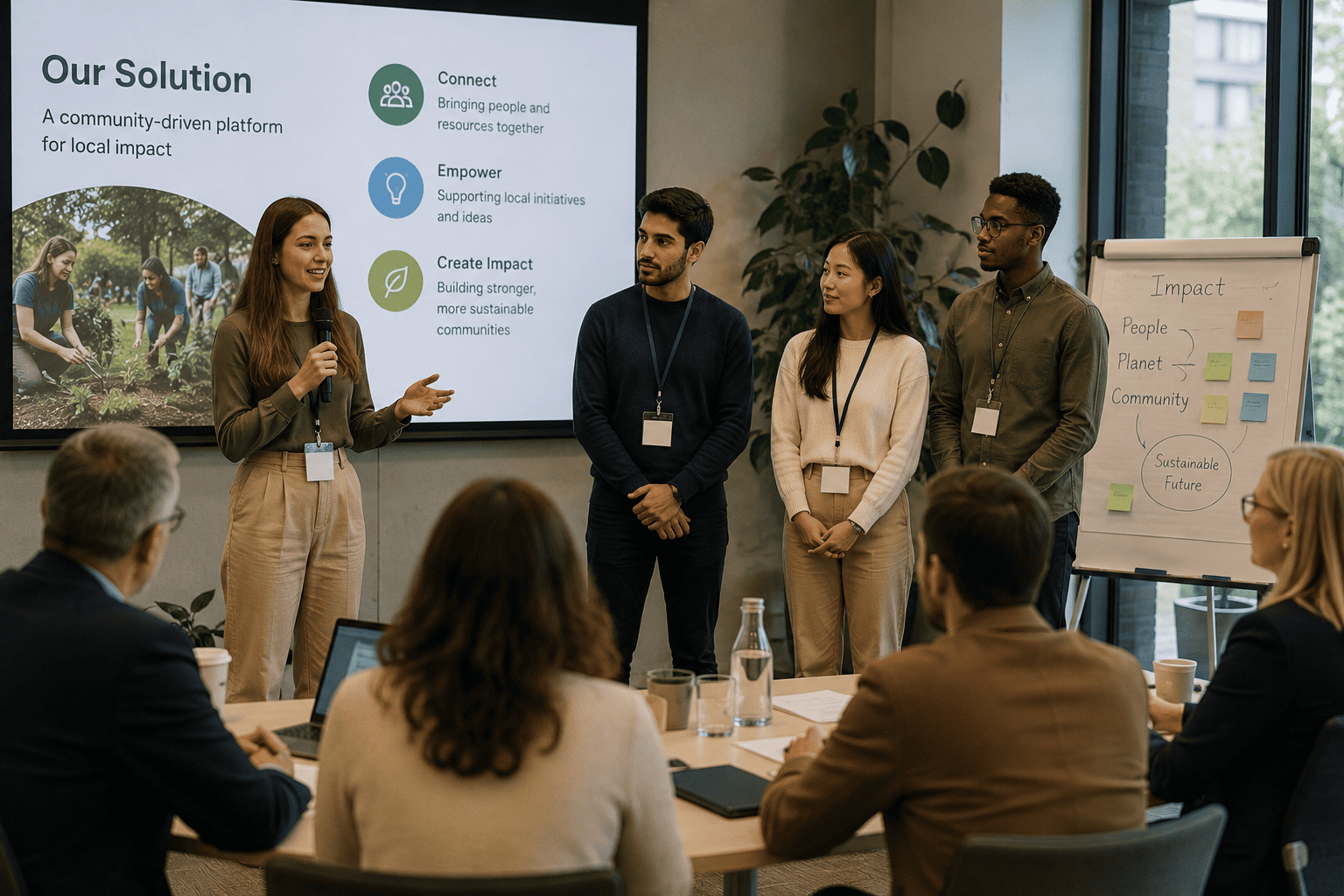
The programme ends with a final pitch in which groups present their prototype concept, explain its potential social impact, and outline first action steps. The goal is not to solve complex challenges completely in five days, but to create structured insight, responsible ideas, and practical next steps rooted in teamwork and thoughtful action.
Target audience
This course is designed for three main target groups:
-
Companies and organisations
For companies and organisations, the course offers a practical professional-development opportunity and, where relevant, a structured space to explore a real social-impact challenge.
The course is especially relevant for employees working in CSR, ESG, sustainability, HR and Learning & Development, innovation, strategy, diversity and inclusion, public affairs, community impact, project management, and team leadership.
Companies that nominate four employees can have a suitable challenge guaranteed as one of the course challenges, subject to course approval. Companies nominating fewer employees still benefit from employee development and cross-company learning, and may propose a challenge for consideration.
Individual professionals join the course to build practical social entrepreneurship and social-impact skills while learning from company perspectives and real organisational dilemmas.
They gain experience with stakeholder analysis, root-cause thinking, active listening, co-creation dialogue, innovation, negotiation, collaboration, prototyping, and pitching. They also learn how companies and organisations approach CSR, ESG, sustainability, inclusion, responsible growth, and community needs.
Students join the course to connect academic learning with real-world practice.
They gain hands-on experience with real company, organisational, or societal challenges, collaborate with professionals and company employees, and build skills in teamwork, communication, active listening, innovation, leadership, negotiation, strategic thinking, coaching, and pitching.
Students are distributed across mixed working groups so they can contribute fresh perspectives while learning from professionals and company participants.
Partner Opportunities
Companies and organisations may contribute real but shareable social or organisational challenges linked to CSR, ESG, sustainability, inclusion, responsible growth, community impact, social entrepreneurship, or social innovation.
The course works with a selected number of suitable challenges, depending on enrolment, partner participation, and available group capacity. This means the course does not depend on having a fixed number of company partners. If fewer companies participate, groups may work with fewer company challenges, partner-organisation challenges, or carefully prepared social-impact cases.
There are three ways for companies and organisations to engage:
1. Nominate four employees
Companies that nominate four employees can have a suitable, real but shareable challenge guaranteed as one of the course challenges, subject to course approval and fit with the learning goals.
The company may choose which employees participate. A mix of senior and junior employees is encouraged. Each approved challenge is explored by a mixed working group, including one representative from the company whose challenge is being explored, together with participants from other companies, individual professionals, and students where relevant.
Companies may also invite a senior or C-level representative to attend the final pitch day and hear the proposals developed during the course.
2. Nominate one to three employees
Companies that nominate one, two, or three employees can still use the course for professional development.
Their employees join the course as individual participants and benefit from cross-company learning, practical social entrepreneurship methods, real organisational challenges, and collaboration with professionals and students.
These companies may still propose a challenge, but the challenge is not guaranteed to be selected. Selection depends on suitability, enrollment, group composition, and available capacity.
3. Sponsor an Impact Seat
Companies may sponsor an Impact Seat for a motivated participant who cannot afford the tuition fee.
This can support talented students, migrants, newcomers, refugees, or emerging change-makers. Sponsored participants are selected by the course team based on motivation, fit, and financial need.
This gives companies a concrete way to support inclusion, access to education, social mobility, and emerging social-impact talent.
All challenges are framed at a social, organisational, or stakeholder level. No confidential commercial data, internal strategy, or sensitive client information is required.
Five-day learning journey
Day 1 — Understanding Social Dilemmas
Participants explore social dilemmas, analyse root causes and stakeholders, and form fixed mixed working groups around approved challenges.
Day 2 — Innovation, Impact & Transformation
Participants explore social innovation, systems thinking, impact awareness, community needs, and ways to move from problem understanding toward meaningful change.
Day 3 — Collaboration, Negotiation & Sustainability
Participants practise active listening and co-creation dialogue, navigate different interests, and balance social, environmental, and economic considerations.
Day 4 — Leadership & Teamwork
Participants strengthen leadership, communication, trust-building, team roles, strategic thinking, coaching, and collective problem-solving.
Day 5 — Prototyping & Commitment
Groups refine ideas, test feasibility and limitations, prepare final pitches, receive feedback, and define first steps for thoughtful action.
Lecturers
Hamed Noori

Hamed is the author of Coaching Across Continents, a handbook shaped by years of practical experience supporting people through change. His career has taken him from entrepreneurship and CEO roles to executive coaching, where he discovered his passion for helping individuals and communities grow.
He founded the Online Coaching Center and the Online Coaching Academy, initiatives that have supported students and individuals across the world and that he continues to build and grow into a diverse community of emerging and experienced coaches. His work now reaches across the EU, where he develops programs that support belonging, understanding differences as a source of learning, and growing together. He has also contributed to major national and international initiatives, including the Dutch National Education Programme (NPO) and the EU MILAGRO project Migrant and Local Grow Together.
Hamed’s contributions have been recognized at Utrecht University with multiple honors: a Diversity and Inclusion Award nomination, a Game Changer in Education Award, and recognition as a Role Model for Student Well-being.
Visiting Experts:
Based on their expertise, the expert will guide specific days in the programme.
Friedemann Polzin

Dr Friedemann Polzin, is an Associate Professor at Utrecht University School of Economics, member of the Sustainable Finance Lab (SFL) and co-founder of the European Centre for Alternative Finance (ECAF). Friedemann holds a PhD in Management and Business Economics from EBS Business School. He investigates the financing of sustainable innovation and entrepreneurship, corresponding organizational, institutional and political arrangements required for a transition towards a sustainable economy. This includes changes to the financial sector itself, such as forms of alternative finance and crowdfunding. Recent projects focus on scaling the hydrogen economy (Hy-Success), improving finance modules in integrated assessment models (DIAMOND), finance and business models for positive energy districts (EmpowerED) and the role of the financial sector for regenerative agriculture (RE-GE-NL). His research has been published in leading innovation, entrepreneurship, management, sustainability and energy journals.
Danielle Vlaanderen

Danielle Vlaanderen has worked for more than 30 years at the Utrecht University in the department of Educational Sciences as an assistant professor. Her areas of expertise are coaching and training (non-directive supporting of learning processes of individuals and groups) and action research.
Important in her development was her training in Transactional Analyses (TA) that brought her more understanding and self awareness of her own patterns in life, and the TA gave her a conceptual framework to understand communication in general in a more profound way.
With Action Research and working with community partners on their questions for change, she experiences the full circle back to her roots in sociology.
Her vision is that learning becomes more meaningful when it is linked to experience. In her courses action learning is a recurring characteristic. The awareness of the full complexity of coaching is part of the learning and within that complexity specific elements are highlighted. As coaches we are never finished with learning and developing; coaching is a way of being. When supporting others in their personal learning journeys as coaches, we need to know what change and learning feels like in our own development.
Bruna Chieko Magaña Izawa

Bruna C. M. Izawa is a legal, governance, sustainability, and compliance professional with over fifteen years of international experience across multinational organizations in Europe, particularly within the energy trading, logistics, and corporate sectors. With a background in law and an LL.M. in Commercial and Company Law from Erasmus University Rotterdam, she has developed strong expertise in sustainability, ESG-related frameworks, legal governance, regulatory compliance, negotiation, and business operations.
Throughout her career, Bruna has worked across legal counsel, contract management, procurement, governance, sustainability, and negotiation functions, supporting international companies and multidisciplinary teams. Her experience includes commercial agreements, stakeholder negotiation, corporate governance, compliance frameworks, regulatory implementation, risk management, and European regulatory developments including GDPR, CSRD, and ESG-related frameworks.
Bruna is passionate about advancing sustainability and building practical solutions that strengthen governance, compliance, and responsible business practices while supporting collaboration across international and multidisciplinary environments. She combines legal expertise, analytical thinking, negotiation skills, and a continuous learning mindset to contribute to sustainable and resilient organizations.
Target audience
This course is designed for three main target groups:
-
Companies and organisations
-
Individual professionals
-
Students
Aim of the course
By the end of the programme, participants will be able to:
- identify and frame a societal or organisational challenge
- analyse root causes, stakeholder perspectives, and affected communities
- step outside their own bubble and engage with diverse perspectives
- apply active listening, communication, co-creation, and coaching skills
- work collaboratively in diverse and cross-company teams
- develop realistic and socially responsible solution directions
- explore feasibility, partnerships, limitations, obstacles, and next steps
- apply practical skills in innovation, leadership, negotiation, sustainability, teamwork, and strategic thinking
- refine ideas based on feedback and real-world considerations
- communicate ideas clearly through a final pitch or presentation
Each working group can work toward:
- a clearer challenge definition
- stakeholder and root-cause insights
- 2–3 possible solution directions
- one prototype concept
- a final pitch or presentation
- a first 30-day action plan
- Communicate their idea clearly and confidently in a final pitch that demonstrates critical thinking and social awareness.
Study load
Participants are expected to complete approximately 5 hours of preparation before the first course day.
Each course day runs from 10:00 to 15:00, followed by group practice from 15:00 to 16:00.
Participants also complete 1–2 hours of homework or preparation each day for the next session.
Working groups are formed on Day 1 and remain fixed during the course.
Costs
-
Course fee:
€795.00
-
Student fee:
€395.00
-
Included:
Course + course materials
-
Housing fee:
€275
-
Housing provider:
Utrecht Summer School
Additional information
The housing costs do not include a Utrecht Summer School sleeping bag. This is a separate product on the invoice. If you wish to bring your own bedding, please deselect or remove the sleeping bag from your order.
For more detailed information on student housing in Utrecht please click here.
Tags