
Course
Getting to Circular Building Economics
To understand how the building construction can transfer into a circular industry, this course offers you a number of instruments that supports you in this task.

To understand how the building construction can transfer into a circular industry, this course offers you a number of instruments that supports you in this task.
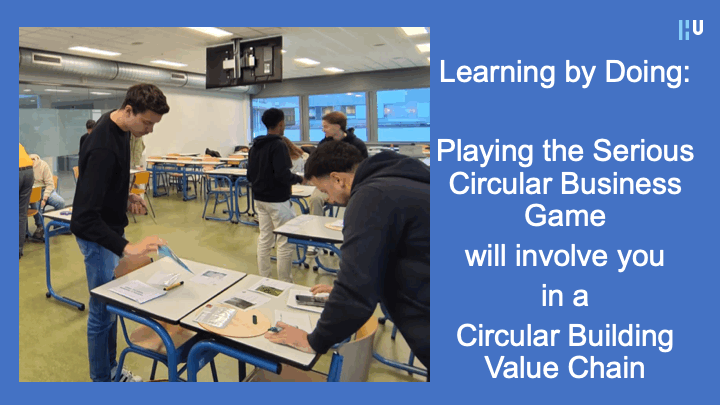
Interested in how the building industry is able to become a circular industry? Working in the building industry, intending to go working in the building industry or being interested in the facets of circularity of this industry are all good reasons to join this one week of learning by doing!
You'll learn via a Serious Game all about what circularity entails; a Business Management Scan will give you understanding of different possible levels of circularity; and through a Behaviour Play you will learn about the importance of behavioural change and its impact on the transition towards circularity for building construction business management.
Project based content with practice experience
The HU research group Process Innovation and Information systems is already working for over three years on a national project that's governmental driven and focusses on the transition from a linear to a circular building industry. The reason (which has an international character) is the degreasing availability of virgin resources combined with the increasing need for more housing and buildings. Besides this, the building industry is hit by the energy transition, the waste transition and the increasing urge for getting more sustainable all due to climate change. Performing research with and for the practitioners in the building industry has delivered many insights in the topic of circularity.
Dr. Marja Exalto-Sijbrands
University of Applied Sciences Utrecht (HU)
Research group Process Innovation and Information Systems
Are you a student interested in working in the building arena after graduation, are you employed by a company in the building construction value chain or are you working as a consultant in the building industry? With this course you will be able to help you (future)company to start adopting circularity in the pace that fits the company.
The aim of this course is to make sure you can work with tools that help you to define a road map that moves a business model into a more circular business model. With other words, through this course you will not only understand what circularity entails in the building construction domain, you will be able to help any company in the building construction value chain to make the transition towards an circular business model by using the models we teach you during this one week.
We will have some articles to read prior to the sessions. All toghether the workload equals to 2 EC of which 5 days 8 hours represents the major part of the workload. This means that the extra reading time is up to 16 hours at most.
The course fee is excluding housing. Living and housing are extra costs you must add to your budget.
This course is part of the two-week Circular Economy track. Alternatively, if you also register for the course, Transition to a Circular Economy: a Business Model Perspective (starting July 6th through July 11th), you will receive a €250 discount on this course (Getting to Circular Building Economics).
While Transition to a Circular Economy: a Business Model Perspective provides a more general understanding of the Circular Economy and the required transition, Getting to Circular Building Economics delves into the business-level details and necessary approaches to achieve a circular value chain, all within the context of building construction.
The housing costs do not include a Utrecht Summer School sleeping bag/inflatable pillow. This is a separate product on the invoice. If you wish to bring your own bedding, please deselect or remove the sleeping bag from your order.
For more detailed information on student housing in Utrecht please click here.
For this course you are required to upload the following documents when applying: